Coming soon!
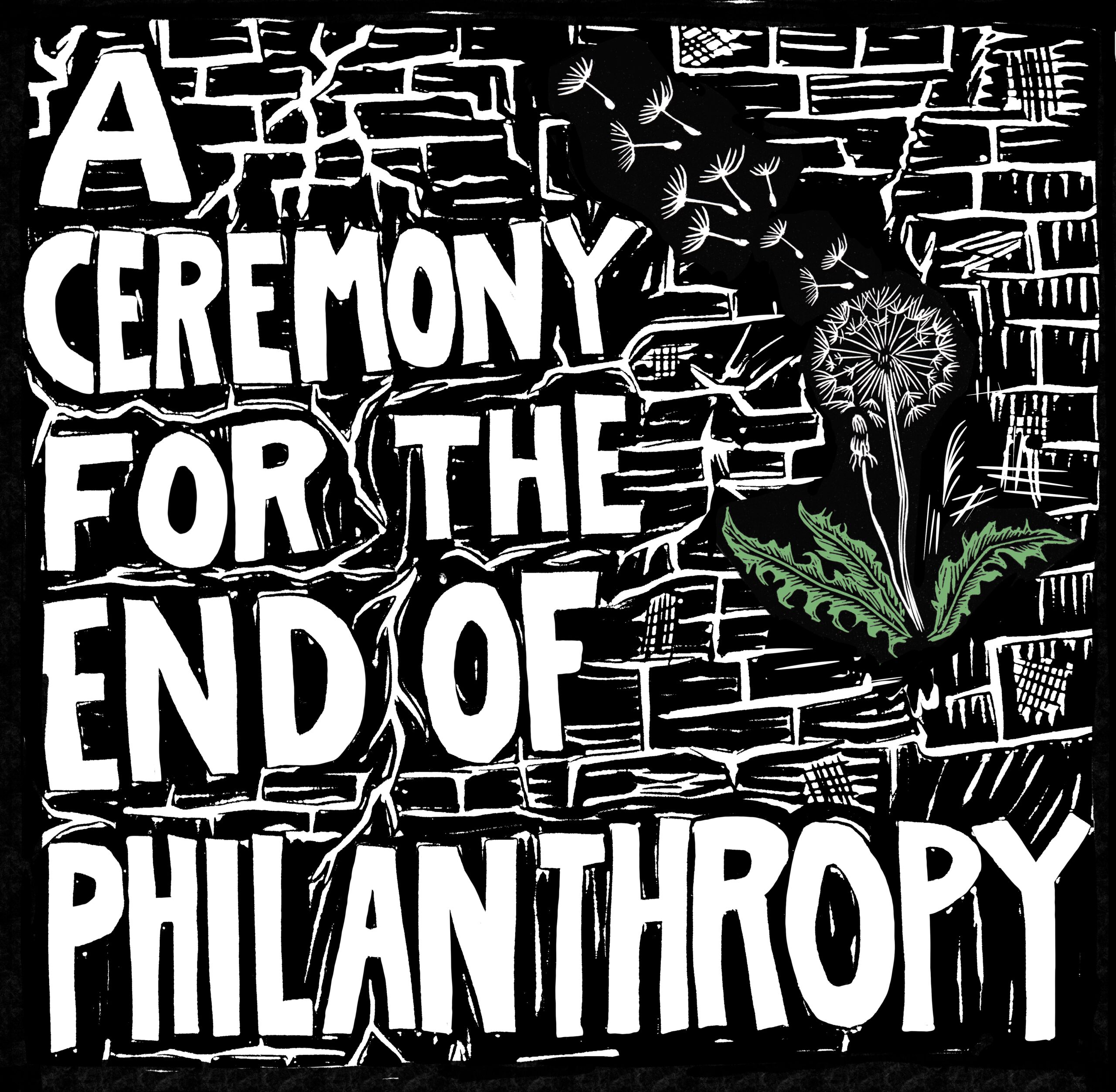
A Ceremony for the End of Philanthropy
A new bookcast written and performed by Karen Pittelman. Produced by Jake Sorgen. Music composed by Karen Pittelman and produced, arranged, and performed by Jake Sorgen with pedal steel by Mike Robinson.
Episode 1: Introduction
The bad feeling. I’ve never quite been able to shake it, even after 25 years in philanthropy. Of course, there are plenty of critiques of this institution—and we’ll cover them all. But I also work in social justice philanthropy, exactly the kind of practice meant to answer those critiques. Still, I’ve always felt in my bones that something was off, though I could not name it. Maybe you’ve felt it too?
Episode 2: Philanthropy’s Paradox
What is philanthropy? What does it do? To document the source of the bad feeling, I have to begin where everyone who’s ever written anything about philanthropy begins. With a definition. But that proves to be a lot harder than you might expect. Philanthropy is slippery. It all boils down to what I call philanthropy’s paradox: in order to maintain its power and legitimacy, philanthropy must both protect the status quo and challenge it at the same time.
Episode 3: The Domain of the Wealthy
Philanthropy has bad boundaries. Bad boundaries with government. Bad boundaries with business. Philanthropy doesn’t even have a clear line between what its donors keep and what they give away. Yet philanthropy still insists its boundaries are just fine, and that, in fact, it’s a part of the “third sector” of civil society, independent from the sectors of government and business. And pretty much everybody in the field goes along with this—even though they know it’s completely absurd.
Episode 4: How Philanthropy Fails
Between philanthropy’s messy boundaries and its frustrating paradox, is it any wonder that this institution has been pissing off critics for centuries? So we come to a brief-as-I-could-make-it-though-not-particularly-brief-but-bear-in-mind-I-am-trying-to-cover-over-250-years review of the long and illustrious history of talking shit about philanthropy. The thing is—if philanthropy has always failed at what it claims to do, why do we keep maintaining it?
Episode 5: How Philanthropy Succeeds
Philanthropy calls itself the “love of humanity.” But what does that really mean? With philosopher Sylvia Wynter as my guide, I go back to the 12th century to discover that when philanthropy says “human,” it only ever means the chosen. And when it says “love,” it only ever means to choose. It turns out that for centuries, philanthropy has been a big success at teaching us the right way to love the right humans by ensuring we select who we share with very carefully. This is how philanthropy trains us to preserve hierarchy and protect inequality. And this is the source of the bad feeling.
Episode 6: Social Justice Philanthropy
Now that we’ve found the source of the bad feeling, we have to return to the proverbial scene of the crime—to where I’d felt it first. In social justice philanthropy. Social justice philanthropy strives to answer all the critiques we looked at in Episode 4. But does it succeed where mainstream philanthropy fails? And more importantly, does it fail where mainstream philanthropy succeeds? Even though social justice philanthropy has been around for over fifty years, these questions are hard to answer because it has a habit of burying its past. What is social justice philanthropy trying so hard to forget? Could it be the bad feeling? I dig up social justice philanthropy’s early history to try to find out.
Episode 7: Money
The fact is, you can run a grassroots organizing group on less than nothing if you have to. But if you want to run a grassroots community fund, you need a lot of cash. Otherwise, you have to raise enough money every year to give it away, and that’s no small task. So the practitioners of social justice philanthropy who transformed the field in the 1970s and 1980s had to grapple with some serious money and power issues to create that change. It wasn’t easy to get the money they needed from rich people and their foundations. But it wasn’t any easier to get that money from a broad base of donors giving small gifts.
Episode 8: Turning Donors into Activists
Some of the most radical grassroots community funds faced an especially thorny challenge. These foundations were carefully structured to ensure that activists who weren’t rich held most if not all of the decision-making power. Yet they still relied primarily on rich people for their budget, which meant those wealthy donors held most if not all of the financial power. But what if rich donors could be turned into activists? Would that make it safer to rely on their wealth? I dive into the story of two long-running attempts at donor transformation to uncover what went right—and what went wrong.
Episode 9: Turning Activists into Donors
While the grassroots community funds were busy turning their wealthy donors into activists, another kind of transformation was taking place. Activists who weren’t wealthy were being transformed into donors. But what exactly did that mean? Activists were activists because they organized collectively to access power. So to become philanthropists, activists would have to start feeling differently about collectivity. They would have to learn to share strategically. Effectively. Carefully. Never collectively. In this way, even as they funded struggles against our interlocking systems of domination, activists-becoming-philanthropists were also being trained to practice selection, and so to keep the inequality those systems required in place. And this was where the bad feeling crept in.
Episode 10: Turning Everyone into Philanthropists
Activists aren’t the only ones being transformed into philanthropists. For decades, some of the field’s biggest foundations have spent millions of dollars trying to inspire “everyday givers—of all backgrounds, genders, races, and ethnicities—to embrace their power as philanthropists,” as the W.K. Kellogg Foundation put it. And according to these funders’ reports, transforming “everyday givers” into philanthropists means helping them shift from “highly personal” sharing into a more “disassociated sense of giving” where they will practice careful selection and objectivity instead. These funders constantly declare that philanthropy is for everyone. Is this what they mean?
Episode 11: Conclusion
Why is it so hard to end philanthropy? What if we rejected its call to selection and unleashed our dangerous desire to share indiscriminately instead? I propose that we need a ceremony because ceremonies can help us to imagine things we don’t yet know how to think. In this final episode, I will share some of my dreams with you about what a ceremony could be and what it might reveal to us beyond philanthropy.